The year 2026 has brought a seismic shift to the digital world. For over two decades, the "search engine" was the undisputed king of the internet. Authors and publishers lived and died by the "Ten Blue Links" on Google. But today, a new player has taken the throne: The AI Agent.
We have entered the era of Agentic Commerce. Readers are no longer just typing "best sci-fi books 2026" into a search bar. Instead, they are turning to autonomous AI assistants—like Gemini, ChatGPT, and specialized literary agents—and asking, "Find me a hard sci-fi novel with a female protagonist, a setting in Lagos, and a writing style similar to Octavia Butler. Once you find it, check the price, and if it's under $10, add it to my reading list."
For the Digital Book Empire, this isn't just a trend; it is a total transformation of how books are discovered, marketed, and sold.
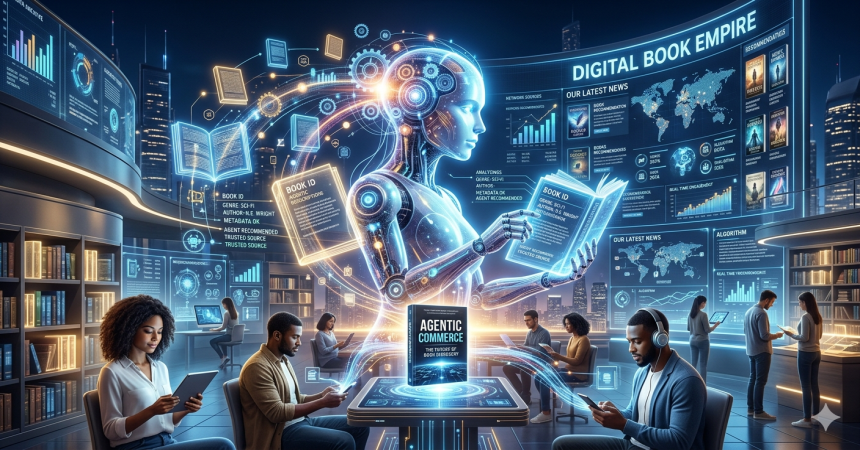
In simple terms, agentic commerce is a system where AI "agents" act as intermediaries between the consumer and the product. Unlike traditional search engines that provide a list of websites for you to browse, AI agents do the browsing, evaluating, and even the purchasing for you.
For the book industry, this means the Reader’s Journey has changed:
Old Way: Search → Browse Websites → Read Reviews → Click Buy.
New Way: Intent → AI Agent Analysis → Single Recommended Result → Automatic Purchase.
If your book isn't "visible" to these AI agents, it effectively doesn't exist in the 2026 marketplace.
Traditional Search Engine Optimization (SEO) was about keywords and backlinks. In 2026, we talk about GEO (Generative Engine Optimization). To build a true Digital Book Empire, you must optimize your content so AI models can ingest, understand, and cite your work accurately.
AI agents don't want to read a 3,000-word fluff piece. They look for "snippable" data. When writing for your blog or book descriptions, use a Fact-Dense approach:
Use H2 and H3 headings that mirror natural questions (e.g., "What are the best Amapiano production guides for beginners?").
Place a TL;DR summary (40–60 words) immediately under your headings. This makes it incredibly easy for an AI agent to "grab" your answer and present it to the reader.
In 2026, Schema Markup (JSON-LD) is no longer optional. It is the language AI agents speak. By using "Book," "Review," and "Author" schema, you are providing a "nutrition label" for your digital assets. This tells the AI exactly who wrote the book, what the genre is, and what readers think of it, without the AI having to "guess" through your creative prose.
There is good news for the Digital Book Empire: books are uniquely positioned to win in the agentic era. Unlike generic household items, books are inherently differentiated. Each title has a unique ISBN, BISAC categories, and ONIX metadata.
Publishers who maintain Clean Metadata—consistent titles, accurate genre tags, and high-quality descriptions—have a significant competitive edge. AI agents "trust" structured data. If your metadata is messy, the AI agent will skip your book for one that it can verify more easily.
In the past, we measured success by "Share of Voice" or "Page 1 Rankings." In 2026, the elite metric is Share of Model.
How often does an AI agent recommend your empire over another?
How frequently is your brand cited as the "authoritative source" for a specific niche?
To win this, you must build Authority through Association. Secure reviews on high-authority sites, engage in digital PR, and ensure your brand name is mentioned alongside industry leaders. AI models learn by seeing patterns; the more often "Digital Book Empire" is mentioned alongside "Quality E-books," the more likely it is to be the top recommendation.
While AI agents handle the discovery, conversion still depends on trust. 2026 research shows that while 70% of readers are happy to let AI find their next book, they still want to feel a human connection to the brand.
This is why "Human-First Authenticity" is your secret weapon. Use your blog to:
Share behind-the-scenes content of your publishing process.
Feature "Expert Spotlights" and verifiable human reviews.
Maintain a consistent, energetic brand voice that an AI can describe but never truly replicate.
To dominate this year, follow these three steps:
Audit Your Metadata: Ensure every book description is updated for 2026 search intent. Use AI tools to find "Natural Language Queries" readers are using today.
Implement an llms.txt File: This is a new standard for 2026. Adding a simple text file to your website helps AI crawlers find your most important content and canonical sources instantly.
Build Your "Moat" with First-Party Data: As AI agents mediate more traffic, "zero-click" searches are rising. Counter this by aggressively growing your email list. When you own the relationship with the reader, no algorithm change can take it away.
The rise of agentic commerce isn't an obstacle; it’s the greatest opportunity for the Digital Book Empire to date. By moving from keyword-stuffing to authority-building and from browsing to "agent-friendly" experiences, you can ensure that when a reader asks their AI assistant for the best digital books in the world, your name is the only one that comes up.
The empire of the future isn't built on links—it’s built on intent, data, and trust.