For decades, the digital book was essentially a digital ghost of its paper ancestor. We took a physical book, flattened it into a PDF or an EPUB, and called it progress. But as we move deeper into 2026, the definition of a "book" is undergoing its most radical transformation since Gutenberg.
The era of the "Static Page" is ending. We are entering the age of the Multi-Modal E-book.
In this new landscape, a book is no longer just something you read. It is something you hear, feel, and interact with. For the Digital Book Empire, staying ahead of this curve is the difference between being a library of the past or a laboratory of the future.
The early 2020s were defined by e-readers that tried to mimic paper as closely as possible. While e-ink still has its place for focused reading, the modern reader—raised on short-form video, interactive apps, and immersive gaming—is looking for a "Lean-In" experience.
Multi-modality means a book that adapts to the reader's environment. In 2026, a premium e-book from a brand like Digital Book Empire isn't just a file; it’s an ecosystem.
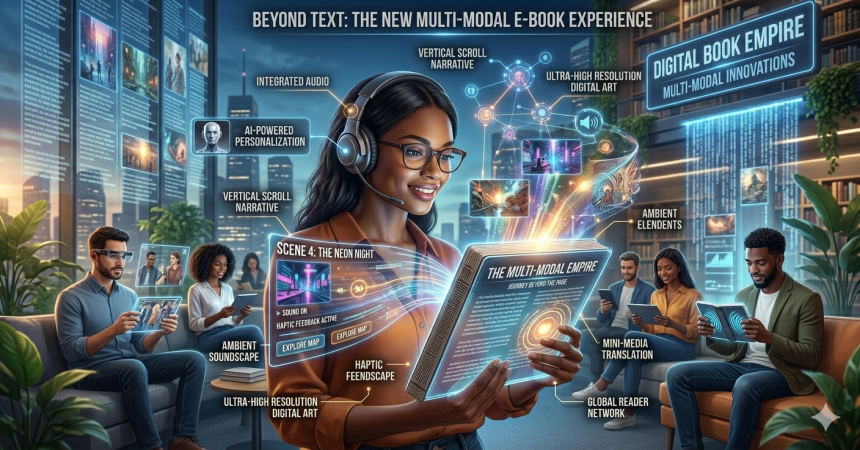
The Hybrid Reader: A reader might start by reading text on a train, switch to an AI-synced narration while walking, and then engage with an interactive map or character summary on their tablet at home—all without losing their place.
Seamless Transitions: We are moving away from "Audiobooks" and "E-books" as separate products toward a single Unified Edition.
One of the most exciting shifts in 2026 is the use of haptic feedback and generative soundscapes.
Imagine reading a thriller. As the protagonist’s heart rate climbs in the prose, your smartphone or e-reader emits a subtle, rhythmic vibration. As the scene moves into a rainy forest, a low-fidelity, AI-generated ambient soundscape of raindrops begins to play softly in the background.
This isn't "multimedia" for the sake of it; it is an Immersive Layer. It’s about taking the reader’s internal imagination and bridging the gap to their physical senses. For the Digital Book Empire, this is where "high-tech" meets "high-touch."
In 2026, the primary reading device isn't just the Kindle; it’s the Smartphone.
Traditional e-books were designed with "pages" in mind. But today’s digital natives prefer the "infinite scroll." This shift in format has profound implications for how authors write:
The Vertical Narrative: Chapters are getting shorter, hook-driven, and visually dynamic.
Mini-Media Elements: Instead of a simple illustration, an e-book in 2026 might feature a 15-second "character reel" or a cinemagraph (a still photo with subtle movement) that sets the mood for the chapter.
Smart Summaries: For the time-strapped reader, a 2026 e-book might include an AI-powered "Catch Me Up" button that summarizes previous chapters if it’s been more than a week since the reader last opened the file.
Artificial Intelligence is the engine driving the multi-modal revolution. In the Digital Book Empire of 2026, the e-book is a "Living Document."
Through AI integration, the book can adapt to its reader in real-time:
Adaptive Vocabulary: For a student reading a complex non-fiction book, the AI can detect if they are struggling with a technical term and offer a context-aware definition in a pop-up window.
Custom Character Guides: As the story grows in complexity, the "Who is This?" feature can provide a spoiler-free biography of a character, tailored exactly to where the reader is in the story.
Dynamic Translation: We are nearing a future where a reader can toggle their book’s language on the fly—not just a machine translation, but a localized, culturally-attuned version that preserves the author’s tone.
With the rise of multi-modality comes a shift in how we sell digital books. If a book is an "experience" that is constantly updated with new ambient soundscapes, character reels, and interactive maps, is it still a one-time purchase?
In 2026, the Digital Book Empire is moving toward Tiered Ownership:
The Basic Edition: Standard text and images.
The Deluxe Multi-Modal Edition: The full sensory experience, with sound, haptics, and interactive elements.
The Living Edition: A subscription-based model where the book is updated with "Bonus Episodes" and community-driven content after the initial release.
This model allows publishers to extend the "long tail" of a book's life cycle. A book is no longer "finished" on its publication date; it is a platform for ongoing engagement.
As we push the boundaries of what a book can be, we must also respect why people read in the first place: Deep Work and Escapism.
The greatest challenge for the Digital Book Empire in 2026 is avoiding "Feature Bloat." We must ensure that the multi-modal elements enhance the story rather than distracting from it. Every sensory addition must serve the narrative.
For some readers, the "ultimate" 2026 experience will be the Deep-Focus Mode—a feature that shuts down all notifications, simplifies the text layout, and provides a pure, distraction-free reading environment. The empire must cater to both the "sensory-seeker" and the "minimalist."
The name Digital Book Empire is a promise of leadership. In 2026, you cannot lead by doing what everyone else is doing. You lead by defining the next frontier.
The transition from "Static Text" to "Multi-Modal Experience" is not just a technological shift; it’s a cultural one. By embracing ambient sound, haptic feedback, mobile-first design, and AI-driven personalization, you are transforming your books from simple files into unforgettable journeys.
The digital book is no longer just a copy of a physical object. It is a new art form. It is time for the empire to start building it.