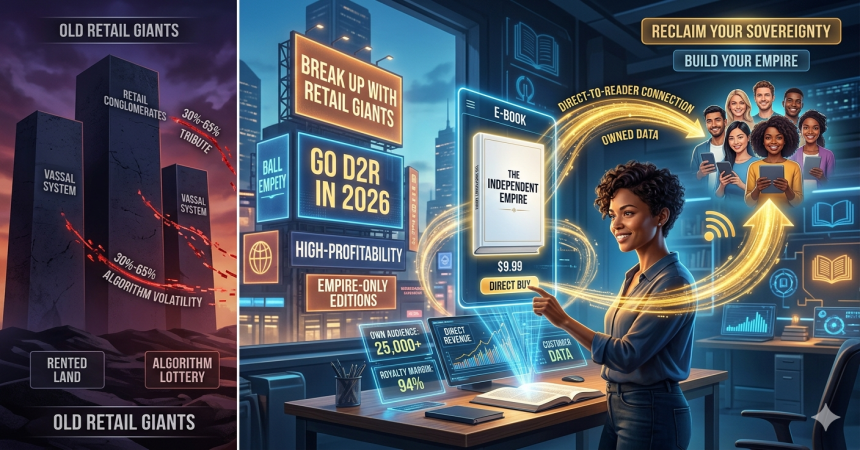
For over a decade, the dream of the "indie author" was inextricably linked to a few massive silhouettes: the "A-zone" and the "Big Five." We were told that to build an empire, you had to pay tribute to the gatekeepers. You gave them 30% to 65% of your revenue, you gave them control over your pricing, and—most importantly—you gave them your customer relationships.
But in 2026, the tides have officially turned. The "Digital Book Empire" of today isn't built on someone else’s rented land. It is built on a foundation of Direct-to-Reader (D2R) commerce.
If you are still relying solely on third-party retailers to sustain your career, you aren't running an empire; you’re running a franchise that can be shut down at the whim of an algorithm. Here is why 2026 is the year to reclaim your sovereignty and go direct.
The biggest risk of 2025 and early 2026 has been the extreme volatility of retail recommendation engines. As AI-generated content flooded major marketplaces, retail giants responded by tightening their algorithms, often burying legitimate, high-quality authors under a mountain of "sponsored" results and low-cost AI filler.
When you sell direct through your own website or platform, the "algorithm" is replaced by Intent. You aren't competing for a spot on a "Customers who bought this also bought..." list. Instead, you are inviting a reader into a curated environment where your brand is the only one on the shelf. In your empire, you decide what is featured, what is discounted, and what is trending.
In the old world of publishing, when a reader bought your book on a major retail site, you received a royalty notification—but you didn't receive a name. You didn't get an email address. You didn't know if they were a first-time reader or a lifelong fan.
In 2026, data is more valuable than the initial sale. Direct-to-reader sales allow you to capture:
Email and SMS Contact: The ability to announce your next launch without paying for ads.
Geographic Insights: Knowing exactly where your "empire" is strongest, allowing for targeted physical events or localized promotions.
Customer Lifetime Value (CLV): Understanding which readers buy every single book and which ones drop off after the first chapters.
When you own the relationship, you aren't just selling a book. You are building a lifetime connection that an AI algorithm can't sever.
Let's talk numbers. For years, authors have been conditioned to accept 70% royalties—and even that was only under specific conditions. In 2026, the cost of living and the cost of content creation have risen. A "Digital Book Empire" needs higher margins to survive.
By going direct, your margins are radically different:
The Old Math: $9.99 sale → Retailer takes $3.00 (30%) → You get $6.99.
The New Math: $9.99 sale → Payment processor (like Stripe/PayPal) takes $0.60 (approx. 6%) → You keep $9.39.
Over the course of a thousand sales, that is an extra $2,400 directly in your pocket. Multiply that across a series, and the difference is the difference between a side-hustle and a true empire.
In 2026, readers are increasingly looking for more than just a standard "digital file." They want Exclusivity. When you sell direct, you can offer "Empire-Only Editions" that can't be found anywhere else:
Digital Deluxe Bundles: An e-book plus bonus chapters, a 30-second AI-generated audio intro, and high-resolution digital art.
Community Access: Access to a private Discord or a forum for readers who buy directly from you.
Pre-Release Early Access: Selling the book 14 days early on your site before it hits the mass-market retailers.
These strategies allow you to charge more and build a sense of belonging for your audience. In the Digital Book Empire, your readers aren't "customers"—they are "citizens" of your brand.
The biggest hurdle used to be friction. In the past, readers found it hard to buy an e-book on a personal site and get it onto their e-reader.
In 2026, those walls have crumbled. New "one-click" delivery tools (like BookFunnel or modernized Shopify apps) allow a reader to buy a book on your site and have it wirelessly beamed to their Kindle, Kobo, or phone in seconds. The "user experience gap" between you and the retail giants has officially closed.
How do you start breaking up with the giants without losing your entire income?
The "Hybrid" Strategy: Keep your backlist on the major retailers for discovery, but make your new launches exclusive to your site for the first 30 days.
The "Direct-Only" Bonus: Inside your books on retail sites, include a prominent call-to-action (CTA) for a free bonus novella—available only on your website. This is how you "migrate" readers from the marketplace into your empire.
Build Your Shopify or LemonSqueezy Store: These platforms are built for the modern digital creator. They handle taxes, delivery, and payments, leaving you free to focus on the writing and the strategy.
Incentivize the Shift: Offer a "Founder’s Discount" for readers who move their subscriptions and purchases to your direct storefront.
The "Digital Book Empire" name is more than a title—it's a mission statement. An empire isn't a vassal state that pays tribute to a king. It is a self-sustaining, independent entity.
By embracing direct-to-reader sales in 2026, you aren't just making more money. You are protecting your creative future, owning your audience data, and building a brand that can survive the shifting winds of the global tech giants.
The walls are down. The tech is ready. The readers are waiting. It’s time to bring them home.